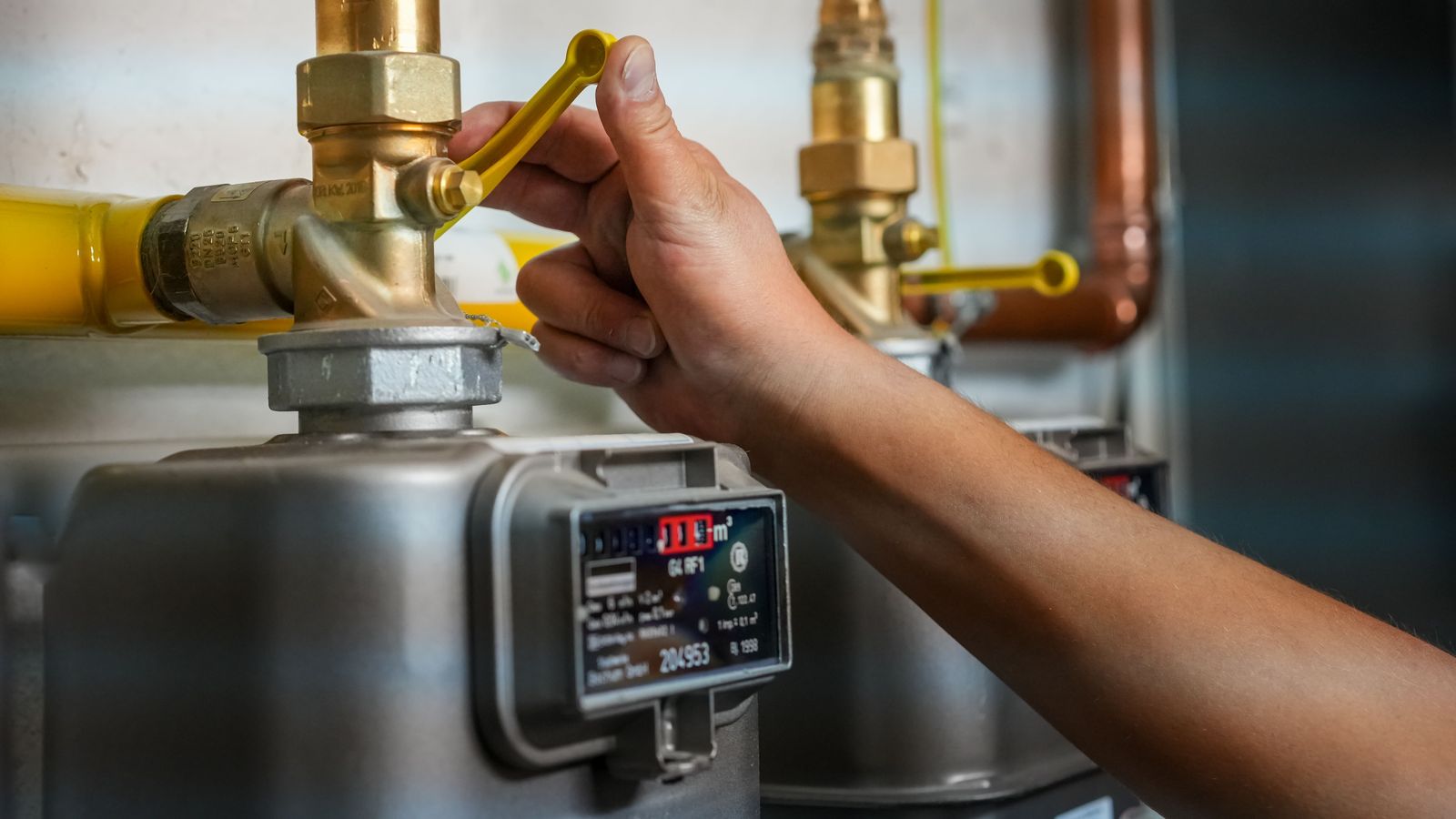
When you need to do this
Most of the time you don't. UK gas bills already convert your meter readings into kWh, and that kWh figure is what you multiply by the emission factor. But there are times you only have the meter: a missing bill, a landlord who recharges gas from a sub-meter, a bill based on an estimated reading, or a site where you want to check usage between bills. In those cases you need to do the bill's arithmetic yourself.
Step 1: work out the units used
Subtract the earlier reading from the later one. Use actual readings, not estimates, and ideally readings taken close to the start and end of your reporting year. Then check which kind of meter you have:
| Meter type | How to tell | What to do |
|---|---|---|
| Metric | The meter is marked "m³" | The difference is already in cubic metres |
| Imperial | The meter is marked "ft³", or your bill says imperial | Each unit is a hundred cubic feet. Multiply by 2.83 to get cubic metres |
Step 2: convert cubic metres to kWh
Gas suppliers use the same formula on every UK bill:
kWh = cubic metres × 1.02264 × calorific value ÷ 3.6
- 1.02264 is the volume correction factor. It adjusts the volume measured by your meter for typical temperature and pressure. It is printed on most bills.
- Calorific value is the energy content of the gas, in megajoules per cubic metre. It varies a little by region and month, and is printed on your bill. Use the figure from the bill for the same period; it is typically around 39 to 40.
- ÷ 3.6 converts megajoules to kWh, because one kWh is 3.6 megajoules.
This calculation uses the gross calorific value, which is how UK gas is billed. That matters in the next step, because DESNZ publishes separate gross and net factors.
Step 3: multiply by the gas emission factor
The DESNZ 2026 factor for natural gas is 0.18231 kg CO2e per kWh on a gross CV basis. Use that one. The net CV factor is 0.20199 kg per kWh, and applying it to billed kWh would overstate your emissions by about 11%. Gas burned in your own boilers or equipment is Scope 1. Our natural gas emission factor page shows the figure for every year back to 2002, so you can use the right one for each reporting year.
A worked example
A small workshop has a metric meter. Its readings at the start and end of the year were 12,480 and 15,880, and its bills show a calorific value of 39.5 MJ per cubic metre.
| Step | Calculation | Result |
|---|---|---|
| Units used | 15,880 − 12,480 | 3,400 m³ |
| Energy | 3,400 × 1.02264 × 39.5 ÷ 3.6 | 38,150 kWh |
| Emissions | 38,150 × 0.18231 | 6.96 tCO2e |
If the same workshop had an imperial meter showing 1,200 units used, the first step would be 1,200 × 2.83 = 3,396 m³, and the rest is the same.
A shortcut, and why the long way is better
DESNZ also publishes a factor per cubic metre of natural gas: 2.02633 kg CO2e. Applied to the example's 3,400 m³ it gives 6.89 tonnes, close to the answer above. The volume factor assumes an average energy content, so the kWh route, which uses the calorific value of your actual gas, is a little more accurate and matches what your supplier bills you for. Use the shortcut as a check, or when you have no calorific value at all, and say which you used.
Common mistakes
- Treating imperial units as cubic metres, which understates use by nearly two-thirds.
- Using an estimated reading as if it were actual.
- Applying the net CV factor to gross kWh.
- Using this year's factor for a previous year's gas.
For electricity, fuel and other energy, our kWh to CO2e calculator does step 3 for you, with the 2026 and 2025 factors side by side.